
Santa Clarita Saunas: Outdoor Barrel Sauna Installation in Santa Clarita
Santa Clarita Saunas covers outdoor barrel sauna installation across the Santa Clarita Valley — a level gravel or concrete base, the barrel's staves, cradles and stainless bands assembled, an electric heater set to its clearances on a dedicated 240V circuit, and a roof and finish chosen for a back yard that sees 100°F summers.
Bookings aren't open yet. Leave your name and number; your message is recorded, and you'll get one message when a local installer is available.
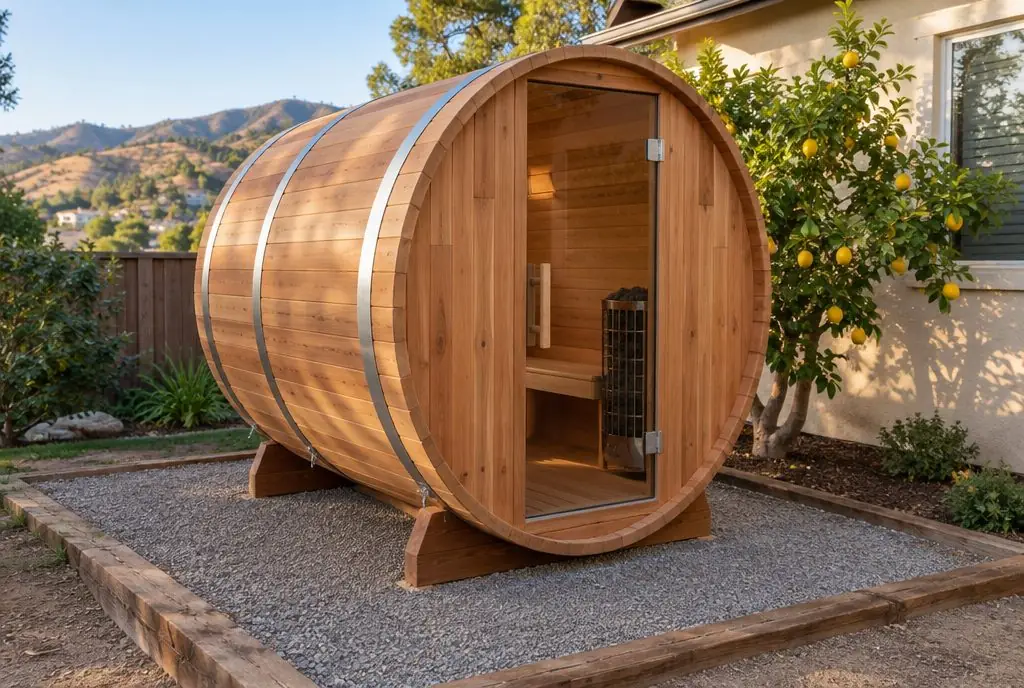 Illustration
What goes into a barrel sauna install
A barrel sauna is a round shell of interlocking wood staves held by stainless steel bands, sitting on two or more curved cradles. Its round interior heats a small volume quickly, which is why barrels are the most requested backyard sauna in the valley.
| Part | Typical spec | What it does |
|---|---|---|
| Staves | About 1.5 in thick, cedar, spruce or thermally modified wood | The walls, floor and roof in one round shell |
| Bands | Stainless steel, with tension bolts | Hold the staves tight as the wood moves |
| Cradles | Two or three curved supports | Carry the barrel and spread its weight on the base |
| Heater | 6–9 kW electric for 2–6 people, or a wood stove | Heats the air and the stones |
| Benches | Two facing benches, sometimes a lower step | Seating at heat height |
| Door | Tempered glass or wood, opens outward | Light and access; no lock |
| Roof | Shingles, membrane or a metal cap over the top | Keeps sun and rain off the top staves |
The base under the barrel
The cradles have to sit dead level, or the staves twist and the door binds. A compacted gravel base of about 4 inches over a weed barrier, edged with timber or steel, is the usual choice; a concrete pad is used where the ground slopes, where the sauna sits on an existing patio edge, or where a tidier finish is wanted. On many valley lots the clay soil moves with the seasons, so the base extends past the barrel's footprint.
- Compacted gravel — drains, simple, easy to level; $600–$1,500.
- Concrete pad — the flattest and longest-lasting; $1,500–$4,000.
- Existing patio — works when it is level and sound; shims under the cradles are not a substitute for level.
The barrel goes where the 240V run is short and the door faces away from the afternoon sun; both decisions are cheaper on paper than after delivery.
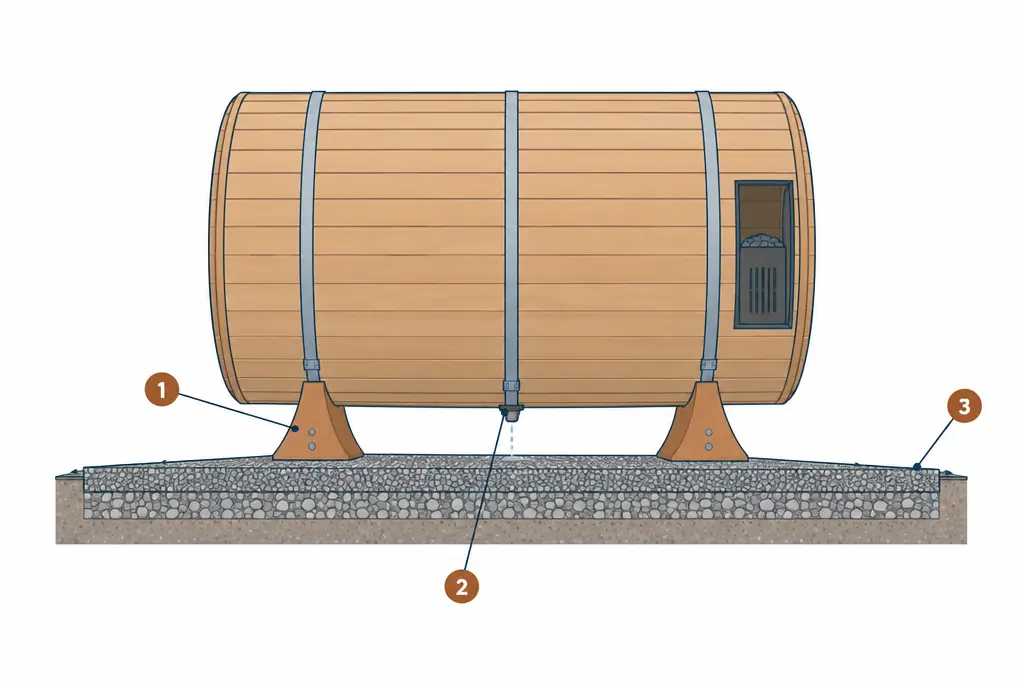
What the numbered markers show
- The cradles sit level on the pad so the staves stay tight and the barrel does not twist.
- A small drain opening at the lowest point lets water out, and the air gap under the staves lets the wood dry.
- The pad extends beyond the barrel and drains away from it, so rain does not pool under the cradles.
Living with wood staves in a dry valley
Wood shrinks in dry air and swells when it is wet. In the valley's long dry summers barrel staves shrink, gaps open between them, and the bands loosen. The fix is routine: tightening the band bolts a little at the start of the dry season and again after the first rains. Thermally modified wood moves less than untreated cedar or spruce. Valley sun weathers the outside to gray unless it is refinished, so a light exterior treatment and a roof cap over the top staves are part of the routine.
A barrel sauna is a wooden boat on dry land — its bands follow the weather.
Sauna and cold plunge combo
Many valley owners put a cold plunge tub beside the barrel. The plunge is a separate appliance: an insulated tub with a chiller that typically needs its own dedicated circuit, water that needs filtration and sanitizing, a level pad that carries the weight of the water, and a drain route for emptying. In valley summers the chiller works hardest, so shade and a lid help. A plunge tub deeper than 18 inches may fall under California's pool and spa safety rules (Health & Safety Code §115921 et seq.); a locking cover keeps children out, and the permit center confirms what applies.
Cold-water immersion causes a sharp gasp reflex and a fast rise in heart rate and blood pressure in the first minute; people with heart conditions ask a doctor first, nobody plunges alone, and sessions stay short. This site gives no health advice. People who are pregnant, have a heart or blood-pressure condition, take medication that affects heat tolerance, or have other medical concerns ask a doctor before using a sauna or a cold plunge. Alcohol and saunas do not mix, and children are supervised.
| Item | Typical choice |
|---|---|
| Tub | Insulated stock tank or purpose-built plunge with lid |
| Chiller | Plug-in unit sized to the tub volume |
| Power | Dedicated circuit for the chiller, GFCI-protected |
| Base | Level concrete or pavers sized for full water weight |
| Placement | Within a few steps of the sauna door, out of afternoon sun |
| Typical installed range | $3,000–$9,000 next to the sauna |
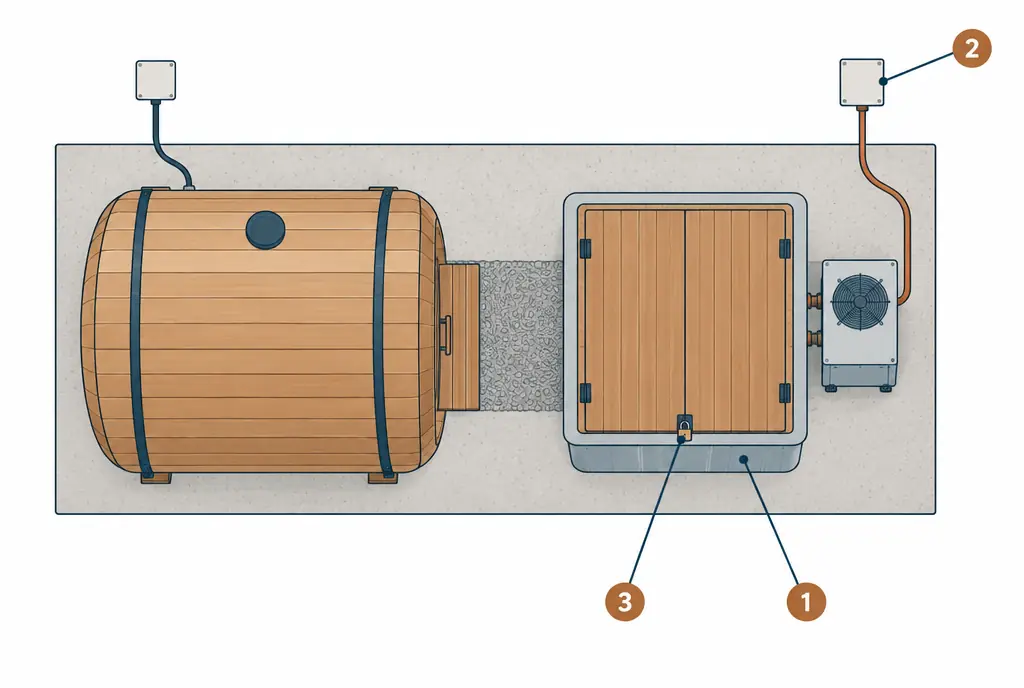
What the numbered markers show
- The plunge tub sits on a level base a short, non-slip walk from the sauna door.
- The chiller typically needs its own dedicated, GFCI-protected circuit, separate from the sauna heater's 240V circuit.
- A locking cover keeps children out when the plunge is not in use; a tub deeper than 18 inches may fall under California's pool and spa safety rules.
Outdoor Barrel Sauna Installation — common questions
How much does an outdoor barrel sauna cost installed in Santa Clarita?
About $8,500–$15,000 for a 2–3 person barrel supplied and installed in 2026; 4–5 person adds $1,500–$4,000. The 240V run adds roughly $12–$30 per foot, so a barrel 40 ft from the panel lands roughly at $8,980–$16,200 before a pad.
Electric heater or wood stove in a barrel?
Electric heaters are the common choice in valley back yards. Wood stoves need chimney clearances and are subject to burn restrictions, and in a Very High Fire Hazard Severity Zone the local rules for wood burning apply.
Outdoor Barrel Sauna Installation: check availability and price range
Bookings aren't open yet — describe the sauna and you get a Santa Clarita price range right here. Typical Santa Clarita Valley installed prices for a residential sauna. This is a market estimate, not a quote. Permit fees, HOA fees and utility company charges, where they apply, are not included.